
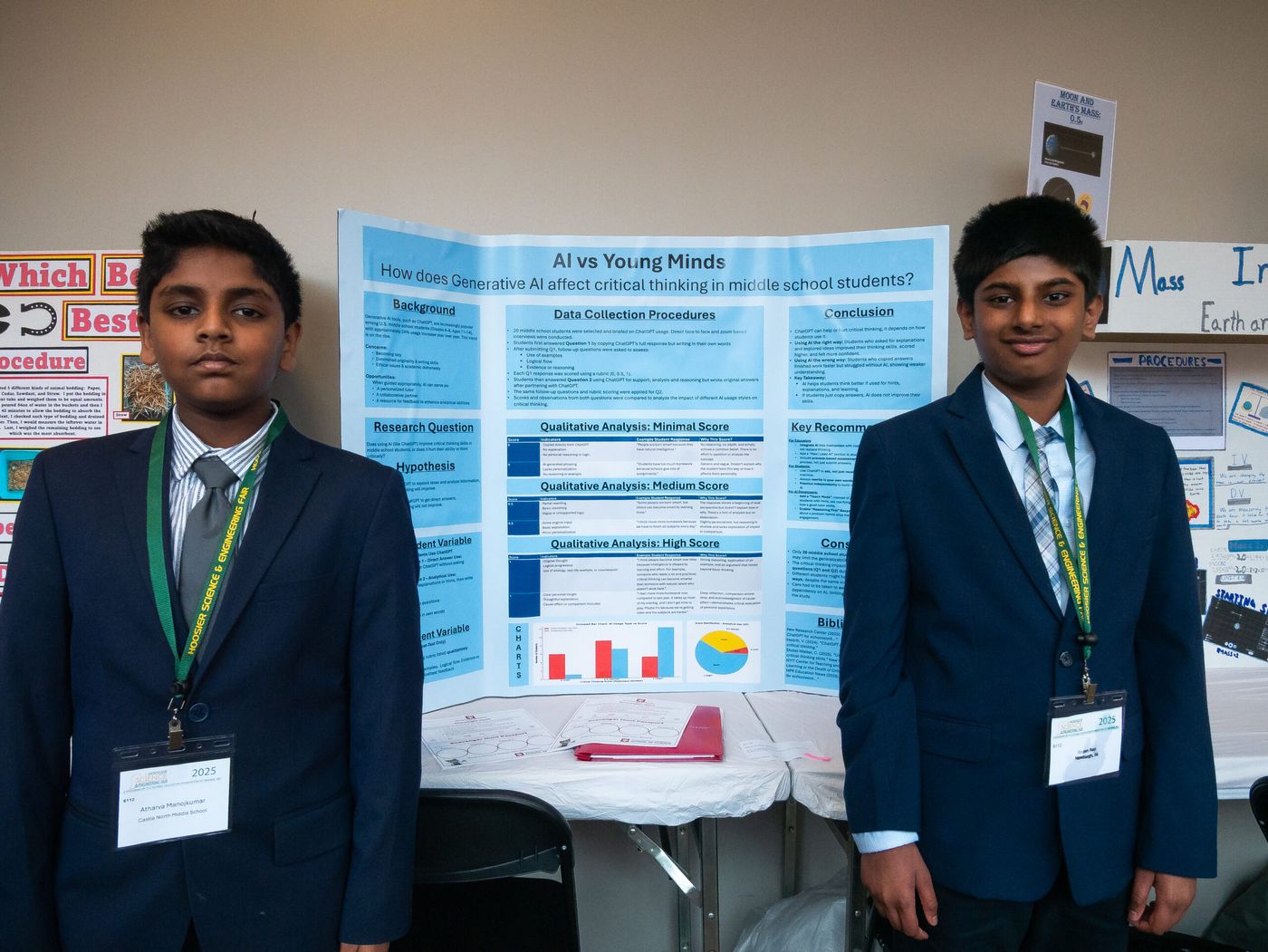
Judge at HSEF
Lend your expertise to Indiana’s most promising young researchers by volunteering as a judge at the Hoosier Science and Engineering Fair.
Serve as a volunteer judge
The 37th annual Hoosier Science and Engineering Fair was held on Saturday, March 28, 2026 on the campus of IU Indianapolis in Hine Hall. Details for the 2027 fair will be posted when they are available.
Submitting the application form is a statement of your willingness to serve as a volunteer judge at the Hoosier Science and Engineering Fair. All judging applicants must read and agree to the following statement before completing the application form.
By completing and submitting the linked form, I agree to serve as a judge for the Hoosier Science and Engineering Fair. I agree to act in a positive and ethical manner in which each student encountered is treated fairly and respectfully. Privileged information or ideas that are obtained through my volunteer service will be kept confidential by me, and I will not use such information or ideas nor disclose such information or ideas to third parties. I agree to disclose all conflicts of interest resulting from direct competitive, collaborative, or other relationships with any of the students and to recuse myself from judging in such circumstances. In conclusion, I agree to notify the Judging Coordinator immediately if I become aware of any circumstance that would potentially compromise my ability to attend the event or evaluate students’ projects.
In signing up to become a judge, you agree to hold yourself accountable to the above statement.
Judge resources
Judging a regional fair?
Regional fair judges register through the Regional Fair Network Registration System.
Register to judge a regional fairDisplay and safety guidelines
The following regulations must be adhered to when a student exhibits a project at HSEF. All projects must also meet the Display & Safety requirements of the affiliated fair(s) in which they compete. Knowing these requirements is the responsibility of the finalist, adult sponsor, and fair director.
Display & Safety Committee mission
The mission of this committee is to ensure that all competitors qualify for competition according to the rules established in conjunction with the Scientific Review Committee and Society for Science.
The HSEF Display & Safety inspection process can be initiated only when all items are present at the display. The Display & Safety Committee will offer guidance on Display & Safety issues for projects approved by the SRC to compete in HSEF. Occasionally, the HSEF Display & Safety Committee may require students to make revisions to conform to Display & Safety regulations. Persistent issues will be directed to a committee of individuals which may include SEFI personnel, Display & Safety (D&S) and/or Scientific Review Committee (SRC) executive committee members.
Maximum size and position of projectDisplay regulations
- Depth: 24 inches (front to back)
- Width: 48 inches (side to side)
- Height: 108 inches (floor to top)
Please be aware when creating posters that the mechanism supporting the poster should conform to the maximum size limitations stated above.
- All project materials and support mechanisms must fit within the project dimensions (including table covers).
- Fair-provided tables at ISEF will not exceed a height of 36 inches (91 centimeters).
- If a table is used it becomes part of the project and must not exceed the allowed dimensions.
- Nothing can be attached to or leaning on the wall.
- All demonstrations must be done within the confines of the finalist’s space. When not being demonstrated, all project components must be returned to the project display and must fit within allowable dimensions as defined above.
- Projects can be continued under the table, but this area is not to be used for storage.
Position of project
The fair-provided table or freestanding display must be parallel to, and positioned at, the back of the project space.
Required formsDisplay regulations
Forms required to be visible and vertically displayed at the project booth (high school projects)
The placement of the required forms may include the front edge of the table, the display board, or a free-standing acrylic frame placed on the table top or floor (if a table is not used).
- Form 1C for projects conducted at a university or registered research institution.
- Form 7 (continuation projects).
Forms required at all projects
- An original Official Abstract and Certification as approved (stamped/embossed) by the HSEF Scientific Review Committee.
- Upon SRC approval, the stamped/embossed Official Abstract and Certification will be provided to the student at their booth. No other format or version of your approved Abstract & Certification will be allowed. No handouts to judges or to the public are permitted.
- The term “abstract” may NOT be used as a title or reference for any information on a finalist’s display or materials (including research papers) at the project except as part of displaying the official stamped/embossed abstract.
Forms NOT to be at the project display booth or in the exhibit area
Completed informed consent/assent forms for a human participant study are NOT to be displayed and should NOT be present at the project display. The student may include a sample (incomplete) form in their logbook or research notebook, but under NO circumstance should completed informed consent/assent forms for a human participant be in the exhibit hall.
Photograph and image display requirementsDisplay regulations
Any photograph, visual image, chart, table, and/or graph is allowed if:
- It is not deemed offensive or inappropriate by the Scientific Review Committee, Display & Safety Committee, or Society for Science (including, but not limited to, images/photographs showing invertebrate or vertebrate animals/humans in surgical, necrotizing, or dissection situations).
- It has a credit line of origin (“Photograph taken by…” or “Image taken from…” or “Graph/Chart/Table taken from…”). If all images, etc. displayed were created by the finalist or are from the same source, one credit line prominently and vertically displayed on the backboard/poster or tabletop is sufficient. All images MUST be properly cited.
Finalists using any presentation or demonstration (physical or digital) outside of a project board must be prepared to show the entire presentation to the Display & Safety Inspectors before the project is approved. All aforementioned rules apply to this presentation, and the presentation may not be altered in any way after the final Display & Safety inspection. Examples of presentations that require approval include, but are not limited to, PowerPoint, Prezi, Keynote, software programs/simulations, and other images and/or graphics displayed on a computer screen or other non-print delivery method.
Items and materials not allowed on display or at the project boothDisplay regulations
- Any information on the project display or items that are self-promotions or external endorsements.
- The use of commercial logos including known brands, institutional crests or trademarks, or flags, unless integral to the project and approved by the SRC via inclusion in the Official Abstract and Certification.
- Any reference to an institution or mentor that supported the finalist’s research, except as provided in an acknowledgement section of the poster and within official ISEF paperwork, most notably Form 1C.
- Any reference to patent status of the project.
- Any items intended for distribution such as disks, CDs, flash drives, brochures, booklets, endorsements, give-away items, business cards, printed materials, or food items designed to be distributed to judges or the public.
- Any awards or medals.
- Postal addresses, World Wide Web, email and/or social media addresses, QR codes, telephone and/or fax numbers of a project or finalist. Note: the only personal information permissible on the display is information also included on the Official Abstract and Certification (finalist name, school, city, state, country). Information regarding a finalist’s age and grade is not permitted.
- Active Internet or email connections as part of displaying or operating the project at ISEF. Exceptions must be requested by email to displayandsafety@societyforscience.org and approved in advance by the Display & Safety Committee.
Not allowed at project or boothSafety regulations
Note: If a student’s project includes an item that is prohibited from display, please consider taking photographs and/or documenting the significance of the prohibited item through video.
- Living organisms, including plants
- Glass
- Soil, sand, rock, cement, and/or waste samples, even if permanently encased in a slab of acrylic
- Taxidermy specimens or parts
- Preserved vertebrate or invertebrate animals
- Human or animal food
- Human/animal parts or body fluids (for example, blood, urine)
- Plant materials (living, dead, or preserved) that are in their raw, unprocessed, or non-manufactured state
- All chemicals including water. Absolutely no liquids can be utilized in the project display.
- All hazardous substances or devices (for example: poisons, drugs, firearms, weapons, ammunition, reloading devices, grease/oil, and sublimating solids such as dry ice)
- Items that may have contained or been in contact with hazardous chemicals (exception: an item may be permitted if professionally cleaned and documentation for such cleaning is available). Filters (including microbial) may not be displayed unless the Display & Safety Committee can reasonably determine that the device was cleaned or was never used (please include receipts in your notebooks and/or logbooks).
- Sharp items (for example, syringes, needles, pipettes, knives)
- Flames and highly flammable materials
- Batteries with open-top cells or wet cells; no battery may be left in the exhibit hall overnight
- Drones or any flight-capable apparatus unless the propulsion power source is removed
- 3D printers unless the power source is removed
- Inadequately insulated apparatus capable of producing dangerous temperatures
- Any apparatus with belts, pulleys, chains, or moving parts with tension or pinch points that are not appropriately shielded
- Any display items that are deemed distracting (for example, sounds, lights, odors)
- Personal items or packing materials stored underneath the table or in the booth overnight
- Any apparatus or project material deemed unsafe by the Scientific Review Committee, the Display & Safety Committee, or the Society
Electrical regulationsSafety regulations
- Electrical power supplied to the project is 120 volt, AC, single phase, 60 Hz. No multi-phase will be available or shall be used. Maximum circuit amperage/wattage available is determined by the electrical circuit capacities of the exhibit area.
- Electrical devices must be protectively enclosed. Any enclosure must be non-combustible. All external non-current-carrying metal parts must be grounded.
- Energized wiring, switches, and metal parts must have adequate insulation and over-current safety devices (such as fuses) and must be inaccessible to anyone other than the finalist. Exposed electrical equipment or metal that may be energized must be shielded with a non-conducting material or with a grounded metal box to prevent accidental contact.
- Decorative lighting or illumination is not permitted.
- An insulating grommet is required at the point where any wire or cable enters any enclosure.
- No exposed live circuits over 36 volts are allowed.
- There must be an accessible, clearly visible on/off switch or other means of quickly disconnecting from the 120 or 220 volt power source.
Laser and laser pointer regulationsSafety regulations
Any Class 1, Class 2, Class 3A, or Class 3R lasers are allowed to be used responsibly. No other lasers may be used or displayed.
- Laser beams may not pass through magnifying optics such as microscopes and telescopes.
- Lasers must be labeled by the manufacturer so that power output can be inspected. Lasers without labels will NOT be permitted.
- Handheld lasers are NOT permitted.
- Lasers will be confiscated with no warning if not used in a safe manner.
Judging criteria
The following evaluation criteria are used for judging at HSEF. Science and engineering projects have different criteria, each with five sections and suggested scoring for each section. Each section includes key items to consider for evaluation both before and after the interview.
Students are encouraged to design their posters in a clear and informative manner to allow pre-interview evaluation and to enable the interview to become an in-depth discussion. Judges should examine the student notebook and, if present, any special forms such as Form 1C (Regulated Research Institution/Industrial Setting) and Form 7 (Continuation of Projects). Considerable emphasis is placed on two areas — creativity and presentation, especially the interview — discussed in more detail below.
Creativity: A creative project demonstrates imagination and inventiveness. Such projects often offer different perspectives that open up new possibilities or new alternatives. Judges should place emphasis on research outcomes in evaluating creativity.
Presentation/Interview: The interview provides the opportunity to interact with the finalists and evaluate their understanding of the project’s basic science, and the interpretation and limitations of the results and conclusions.
- If the project was done at a research or industrial facility, the judge should determine the degree of independence of the finalist in conducting the project, which is documented on Form 1C.
- If the project was completed at home or in a school laboratory, the judge should determine if the finalist received any mentoring or professional guidance.
- If the project is a multi-year effort, the interview should focus ONLY on the current year’s work. Judges should review the project’s abstract and Form 7 (ISEF Continuation Projects) to clarify what progress was completed this year.
- Team and individual projects are judged together, and projects should be judged only on the basis of their quality. However, all team members should demonstrate significant contributions to and an understanding of the project.
Science projects100 points in five sections
I. Research Question (10 pts)
- Clear and focused purpose
- Identifies contribution to field of study
- Testable using scientific methods
II. Design and Methodology (15 pts)
- Well-designed plan and data collection methods
- Variables and controls defined, appropriate, and complete
III. Execution: Data Collection, Analysis and Interpretation (20 pts)
- Systematic data collection and analysis
- Reproducibility of results
- Appropriate application of mathematical and statistical methods
- Sufficient data collected to support interpretation and conclusions
IV. Creativity (20 pts)
- Project demonstrates significant creativity in one or more of the above criteria
V. Presentation (35 pts)
a. Poster (10 pts)
- Logical organization of material
- Clarity of graphics and legends
- Supporting documentation displayed
b. Interview (25 pts)
- Clear, concise, thoughtful responses to questions
- Understanding of basic science relevant to project
- Understanding interpretation and limitations of results and conclusions
- Degree of independence in conducting project
- Recognition of potential impact in science, society, and/or economics
- Quality of ideas for further research
- For team projects, contributions to and understanding of project by all members
Engineering projects100 points in five sections
I. Research Problem (10 pts)
- Description of a practical need or problem to be solved
- Definition of criteria for proposed solution
- Explanation of constraints
II. Design and Methodology (15 pts)
- Exploration of alternatives to answer need or problem
- Identification of a solution
- Development of a prototype/model
III. Execution: Construction and Testing (20 pts)
- Prototype demonstrates intended design
- Prototype has been tested in multiple conditions/trials
- Prototype demonstrates engineering skill and completeness
IV. Creativity (20 pts)
- Project demonstrates significant creativity in one or more of the above criteria
V. Presentation (35 pts)
a. Poster (10 pts)
- Logical organization of material
- Clarity of graphics and legends
- Supporting documentation displayed
b. Interview (25 pts)
- Clear, concise, thoughtful responses to questions
- Understanding of basic science relevant to project
- Understanding interpretation and limitations of results and conclusions
- Degree of independence in conducting project
- Recognition of potential impact in science, society, and/or economics
- Quality of ideas for further research
- For team projects, contributions to and understanding of project by all members
Ready to judge?
Read the statement above, then register through our judging system.